

This post was originally published on Substack.
Not too long ago, I explored the etymology of Superman’s “Triangle Era” in the comics. It’s an era with a very specific beginning and end, but that hasn’t stopped fans from creating their own colloquial definitions that carry as much or more weight than the one approved by DC.
That whole conversation flowed out of an interaction I had with somebody I’d consider a Superman expert, Superman & Lois writer Adam Mallinger. I found it to be an interesting exchange, and one worth digging into, and a good time was had by all.
Now, there’s a Superman movie coming to theaters in less than a week. One popular meme that has been circulating on social media views the film through a decidedly contemporary lens:
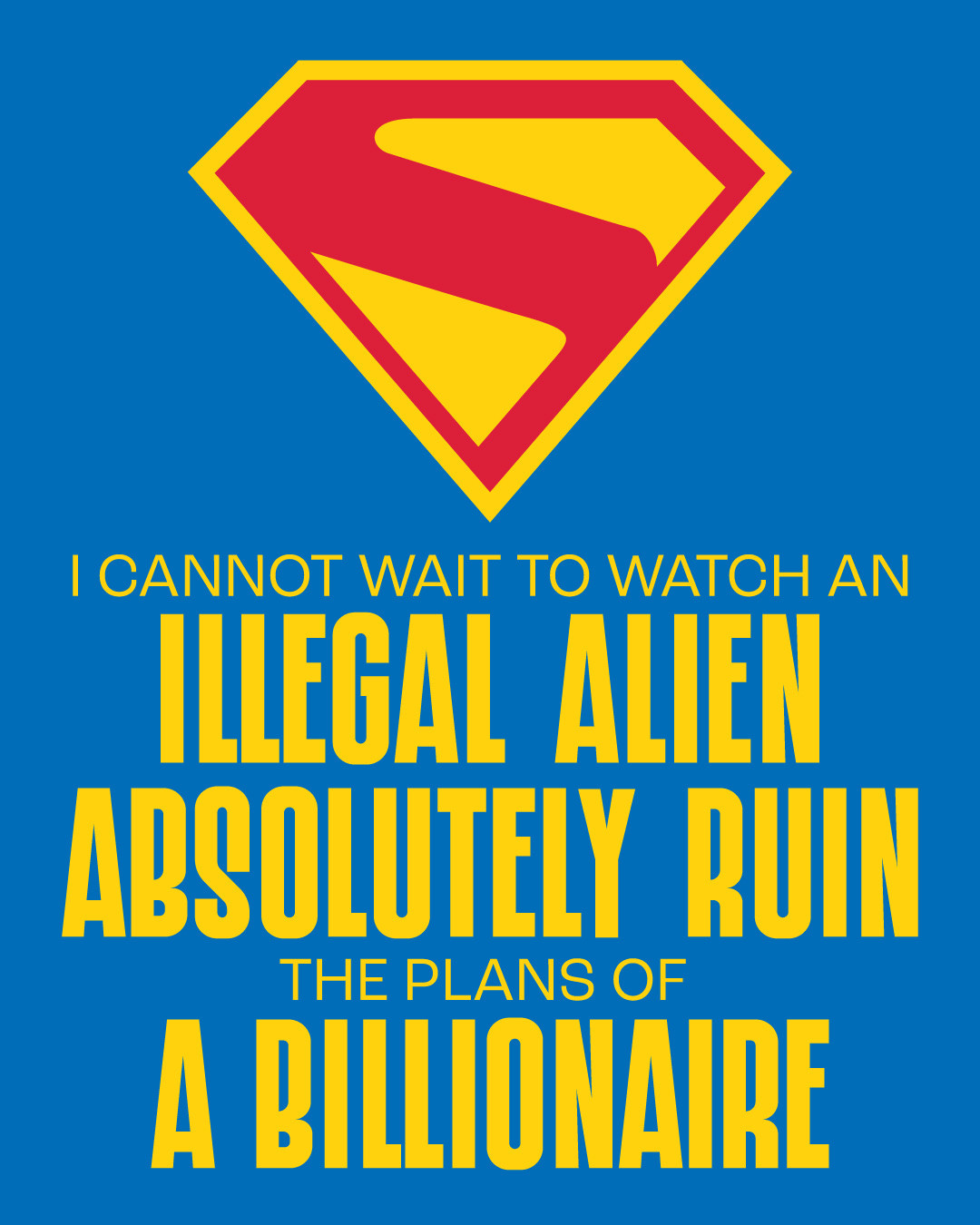
Superman’s life has often been referred to as an “immigrant story.” Sent to Earth as a refugee from a doomed world, Superman assimilated to American culture and became famous and beloved all over the planet, in a way that only a postwar American could be.
The degree to which “immigrant” was key to Superman’s identity is variable depending on the writer, as is the degree to which his alien heritage is important. In Richard Donner’s Superman: The Movie, the issues go almost completely unexplored, while the idea of First Contact with aliens was central to the way Zack Snyder’s Man of Steel was envisioned, executed, and marketed.
Film blogger Larry Oliver, who is apparently the latest in a series of film writers attending early screenings who are just itching to spill tea about the movie, replied to this meme on Bluesky with the comment, “[Superman is] a meta human, whatever that is.”
[Studios: I am absolutely begging you to invite just one person who has engaged honestly with the last decade of DC superhero content on TV and film to these events.]
I corrected Oliver, saying that there’s a difference between metahumans and aliens, and he rebutted that I should “watch the movie.” So, presumably, the upcoming James Gunn Superman film refers to Superman as a metahuman. Let’s dig into that.
Metahumans (Whatever They Are)
“Metahuman” is, loosely speaking, DC’s equivalent of “superhuman.” It was coined in the DC miniseries Invasion! in the 1980s and is roughly analogous to Marvel’s mutants. It is, technically speaking, a human who possesses the “meta-gene,” an anomaly that could (but doesn’t always) cause them to develop super-powers. Wildstorm’s “Gen-Active” population is more or less the same thing, and now that DC owns Wildstorm and have folded them into the wider DCU, gen-actives are just a sub-population of metahumans.
Metahumans are, definitionally, biological humans who develop (or are born with) powers. Technically speaking, this means huge swaths of DC heroes and villains aren’t “metahumans.” There are people like Batman, Green Lantern, or Booster Gold, who are regular humans whose extraordinary abilities come from their advanced training or technology. There are also aliens — characters from other worlds. We know that aliens aren’t technically metahumans, because in DC’s canon, some of Earth’s earliest metahumans (and the metagene itself) were found and experimented on by White Martians, a group of monstrous, powerful aliens who hoped to harness the metagene to create enhanced versions of themselves.
Note: fellow pedant and Booster Gold superfan Boosterrific noted in an email, “Technically, Booster does inherit the generic gifts given to select humans by the Oans in Millennium (as evidenced by his ability to reject Monarch II’s Trojan arm), so he’s not a great example of baseline homo sapiens.”

If you haven’t read comics, you likely would have heard the term “metahumans” on The CW’s Arrowverse, a shared multiverse of DC stories that played out over hundreds of hours of TV on Arrow, The Flash, Supergirl, DC’s Legends of Tomorrow, Batwoman, and Black Lightning. The idea of “metahumans” in the Arrowverse was baked in as soon as powers were discovered, with the term appearing in virtually every episode of The Flash, which ran for almost a decade and was the network’s most popular series for virtually all of that time.
(Fun fact: The Arrowverse actually adapted the Invasion! storyline as the first of their line-wide events to feature Supergirl and the Legends.)
Because the plurality of DC’s heroes and villains are metahumans, it’s not uncommon to use “metahuman” as colloquially analogous to “superhero/supervillain” both in DC’s content and in discussion of that content. It’s an example of a fairly common phenomenon: things that are similar enough become colloquially “the same” even if they are technically different. Those distinctions may seem meaningless to some, but when engaging in a conversation that starts from the first principle “Superman is an alien,” the distinction is important.
For a real-world example of this phenomenon at work: many Americans will refer to a number of African and East Asian populations as “Middle Eastern,” despite their countries of origin existing outside of the Middle East. In most cases, people won’t bother to correct you because the use is colloquially correct even if it’s literally wrong. The fact that it’s wrong often doesn’t matter in the context of the discussion, and is not worth derailing the original point to discuss a tangentially-related one.
So, is Superman a metahuman or an alien?
Colloquially, he can be both. Literally, he is an alien.
I’ll add: if the Gunn movie establishes him as a metahuman, it may one of two things: the world at large might not yet know that Superman is from another world…or the movie could simply be using a different definition of the term than has been conventionally accepted. If the latter is true, that means in-universe, Superman may in fact be a metahuman…but that would still not prevent him from being a literal alien from another planet. Looking to the real world again, being white doesn’t change the fact that Elon Musk is African (even if he doesn’t look the way most white Americans picture Africans).
Would you believe there’s actually a second half to this discussion that didn’t originate on Bluesky…?
The Birthing Matrix Question
Oh, yeah, baby, we’re headed back into Byrne-era Superman discourse! I’m home!
This one is less of a terminology question than the metahuman issue, but no less pedantic. While that question centered on whether Superman qualifies as “alien,” this one centers on the question of illegality.
Superman arrived on Earth, and was taken in by a kindly farmer couple from Kansas. In most iterations of the story, his “secret identity” began the moment the Kents decided to pretend he was their natural-born son and register his birth with the state, rather than admitting they had found an abandoned baby and adopted him.
By that standard, the government understand Clark Kent to be a normal human born to American citizens on American soil, leaving little room for controversy as to whether he is an American citizen.
(No, I’m not going to get into the David Goyer story where Superman renounced his U.S. citizenship to become a “citizen of the world. That isn’t the question here.)
Superman is a slightly different story — the government doesn’t know where he came from, where he was born, or who his parents are. This creates ambiguity that, at least in theory, is interesting to examine.
Since the DC Universe is chock full of alien beings who live on Earth, we’re going to assume for the sake of argument that they qualify as people whose rights are roughly the same as anyone born on Earth. There have been some times — notably during 2011’s New 52 reboot — when aliens were hated and feared, but that is the exception rather than the rule in DC. Typically, when the question of extraterrestrial citizenship comes up, it’s as part of a specific storyline, rather than the status quo of the storytelling universe.
There are also different iterations of Superman’s origin story, and some have argued that’s where “illegality” could really come into question.
While most extraterrestrials arrive while adults, do their thing, and are documented officially at some point, Superman’s arrival was kept secret by Jonathan and Martha Kent. And depending on the version of his origin you read, he may or may not have been “born” here.
Prior to John Byrne’s mid-80s reboot The Man of Steel, Superman was generally depicted as having been born on Krypton, then sent to Earth in a rocket as an infant. Once in Kansas, he was adopted by the Kents.
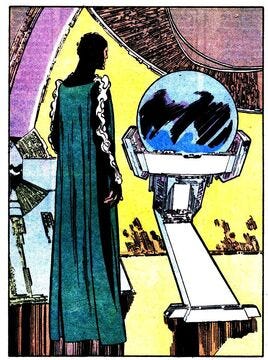
Byrne’s reboot introduced a new concept to the lore: a Kryptonian “birthing matrix.” In Byrne’s version of the story, a fetal Kal-El was sent to Earth, developed in an artificial womb, and was “delivered” on the day his craft crashed on Earth, with an egg-shaped cockpit melting away and amniotic fluid draining away.
Fairly unambiguously, the pre-Byrne version of Superman was born on Krypton and sent away as a refugee. The Byrne-era version was “born” on Earth to parents from Krypton, and adopted immediately after birth.
Over the years, there has been some argument (in the dark corners of the internet that likes to entertain these kinds of conversations) that the Byrne-era Superman is, then, fully American as a result of birthright citizenship, while prior iterations got citizenship by virtue of the Kents lying on his birth certificate.
Birthright citizenship, enshrined in the U.S. constitution with the ratification of the 14th Amendment in 1868, holds that if you were born in the United States, you have citizen by virtue of birthright, regardless of your parents’ immigration status. It was primarily ratified to provide citizenship rights to freed slaves, but has applied more broadly for over 150 years.
Of course, Superman (2025) will be releasing in June 2025, and that means birthright citizenship is now in doubt for the first time since the U.S. Civil War. U.S. President Donald Trump has issued an executive order instructing law enforcement to reject the notion of birthright citizenship, and last week the U.S. Supreme Court ruled that, at least until it’s more settled as a matter of law, law enforcement is obliged to abide by the executive order, except in cases where there are clear laws (or pending injunctions) preventing it. As of now, the state of Kansas — a Republican stronghold, where Trump’s word is effectively Gospel — has no such protections for U.S.-born children of immigrants.
So, unless there’s some new aspect of the lore being introduced in Superman, which is of course possible, it seems as though, yes — Superman is in the country illegally.
So, yes, Superman is an illegal alien.
You can support me on Patreon for just a dollar here.
Other great comics folks to support:
Other recent stories to check out from Russ Burlingame:
- On Zack Snyder and Adaptations
- The Etymology of the Post-Crisis Superman
- Bruce Springsteen Just Announced A Box Set That Will Recontextualize His Whole Legacy
- Cleveland Guardians Announce Superman Night In the Stadium




 Emerald City Video
Leave a comment