
No, you’re good, it really is as nerdy as it sounds.
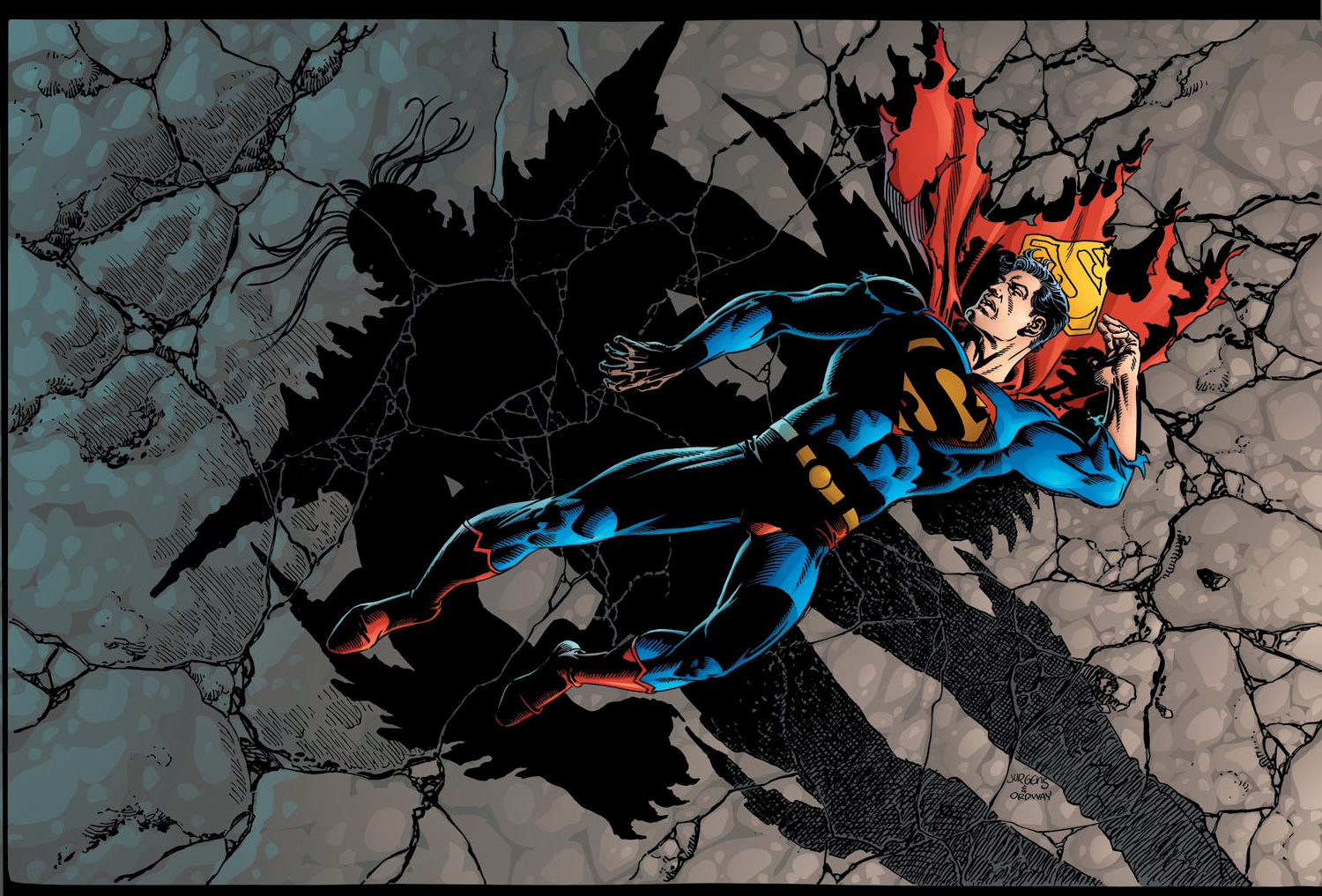
Earlier this week, a new piece I wrote ran on Comic Book Club. I’m pretty happy with how it came out, but I got some feedback over on Bluesky from Superman & Lois writer Adam Mallinger, which I felt was worth digging into.
In short, I used a fairly loose definition of Superman’s “Triangle Era” in order to make a larger point. When Mallinger corrected me, I told him that I actually agree with him, but that I was being colloquially correct rather than technically correct.
I half-joked that, maybe there needs to be an additional term invented for the “version of Superman” that I was actually talking about, so let’s dig down into the backstory, the era, and why I was both right and wrong when broadly defining the Triangle Era.
Most comic book “eras” are loosely defined, but there are a few points of demarcation that are more clearly evident. The biggest, in terms of impact on continuity and a company’s brand identity, was DC’s Crisis on Infinite Earths.
The mega-event, which ended DC’s multiverse and streamlined its continuity into a single, cluttered timeline, ran from 1985 until early 1986. Shortly after that, Superman was officially rebooted with The Man of Steel, a 1986 miniseries from superstar writer/artist John Byrne.
The Man of Steel reinvented Krypton, making a sterile, science-obsessed society which had inadvertently caused its own doom not only by tainting the environment but by linking its citizens to the planet, making it impossible to evacuate in case of a catastrophe.
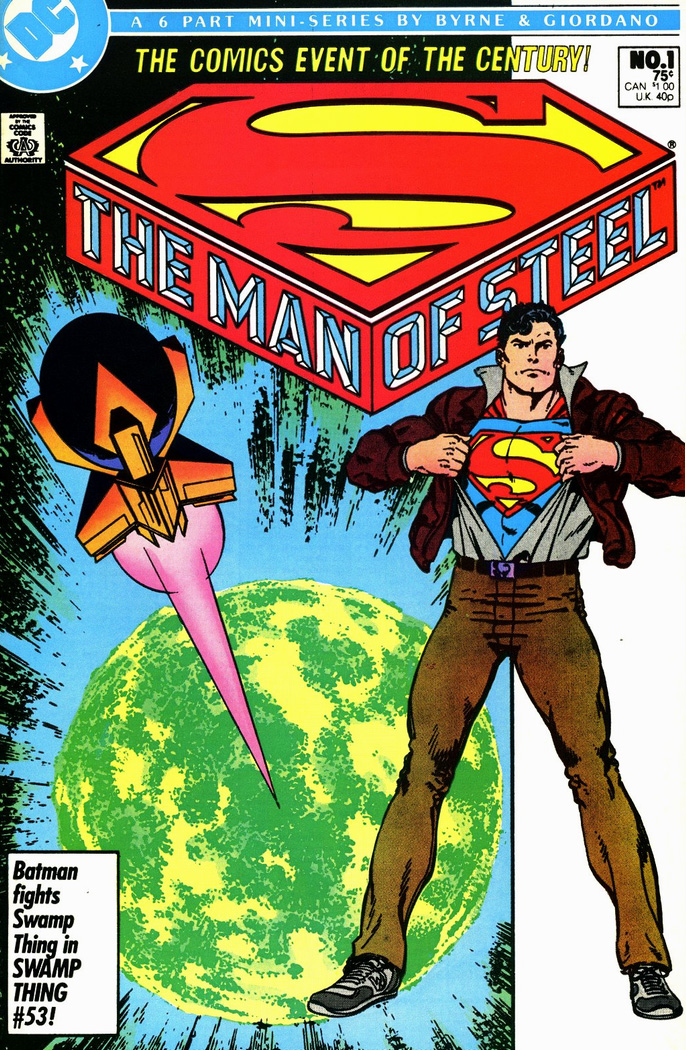
The Man of Steel marked the official beginning of the post-Crisis era. While there had been some comics published in between the end of Crisis on Infinite Earths and the beginning of The Man of Steel, those were holdovers from the pre-Crisis continuity, with a notable post-script in the form of Alan Moore’s beloved Whatever Happened to the Man of Tomorrow?, billed as the final story of the pre-Crisis Superman.
In the post-Crisis era, Superman’s powers were significantly scaled back, creating a version of the character who needed assistance to breathe in space and who could throw an uprooted city block, but not a whole planet. The comics also had a significantly more interconnected continuity, with Byrne and Marv Wolfman working together on three different Superman titles, telling a single, ongoing story between them.
That philosophy would continue through until 1999, but along the way, one of the most defining elements of the post-Crisis era would manifest itself: the Triangle Numbers.
Since there was an ongoing story being told by various creative teams across multiple titles, the Superman editorial office decided in 1991 that they would do something novel to make it easier for fans to follow along. On each cover, there would be the standard issue number in the cornerbox, but elsewhere on the cover would be a triangle, which featured the year, and another number.
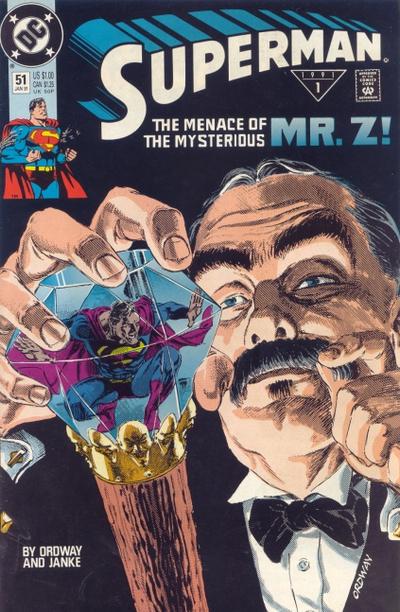
That number would indicate the sequence in which the comic would be read, and it carried over across all of the Superman titles in print at the time. For instance, the first Triangle Number — 1991 – 1 — was on Superman #51, while 19991 – 2 was on The Adventures of Superman #474.
At that point, there were three monthly Superman titles. Shortly thereafter, they would roll out a fourth, titled Superman: The Man of Steel. Later, a quarterly book called Superman: The Man of Tomorrow would roll out, guaranteeing that (for a time) Superman would be in print every week of the year.
In 1999, Dan Jurgens left the Superman titles with Superman #150, and Superman: The Man of Tomorrow wrapped up. This marked the end of an era colloquially referred to as the “‘86-’99” years, which inspired a popular blog that has a love-hate relationship with the period.
That was where I left the books as a regular monthly reader — the loss of Jurgens, Louise Simonson, Jon Bogdanove, and other creators I had followed for years left me cold — and where Adam Mallinger returns to the picture, suggesting that his take on the “Triangle Era” ends here.
Officially, the “Triangle Era” ends a few years later, in 2002, when DC stopped putting the guideposts on the cover. That said, it’s fair to argue that Adam is right because, as he noted on Bluesky, “the guys who came in during 2000 looked at a cohesive continuity that had been built upon for almost 15 years and decided to start hacking away at the foundations without any respect for how it undermined [‘The Death and Return of Superman.]’ [Roger] Stern & [Jerry] Ordway seem to not have been fans of Byrne’s final story, but rather than sweep it away, they used it, and built on it so that it led somewhere. The 2000s guys were like, ‘You know that Krypton that’s foundational to… EVERYTHING, but especially the Eradicator? Didn’t happen. It’s a lie.’ And that put every team from 2000s to Infinite Crisis in the position of having to explain how
“Death and Return” was possible when some of the biggest Jenga pieces were taken out. Return to Krypton is one of my least favorite sagas specifically for the continuity nightmare it caused.”
I can’t agree enough. While a lot of people were very excited to see a new era start with “Return to Krypton,” I actually bailed on the comics — which I had been reading weekly since 1992 — after that story.
That said, there are two more landmarks to pay attention to.
In 2002, DC ran “triangle numbers” — which were actually now inside pentagons inspired by the shape of the Superman logo — for only four weeks before giving up on them. Still, one could easily argue that in early 2002, the Triangle Era “officially” ended at DC.
Then, there came Infinite Crisis. The crossover event undid many of the biggest results of Crisis on Infinite Earths, and during it, The Adventures of Superman ended. With both Man of Tomorrow and Man of Steel having already ended, the conclusion of Adventures left only two monthly Superman titles (Superman and Action Comics) still running, and the continuity changes officially marked the end of the “post-Crisis” era.
For many fans, they think of the Triangle Era of lasting between The Man of Steel and Infinite Crisis. That isn’t factually true, but it proves a solid narrative. There’s actually a really great podcast called From Crisis to Crisis, on which I have appeared a few times.
For Mallinger, there are three eras, with two contained within the last:
Triangle Era – Exile to Superman 150, but fair game to include Byrne.
Post-Crisis – From MAN OF STEEL to INFINITE CRISIS
Pre-Flashpoint – MAN OF STEEL to New 52
I certainly like that list. I tend to refer to Mallinger’s “Post-Crisis” era as the “From Crisis to Crisis” era, because as suggested, I love the podcast of that same name that covers the era.
In any case, I’m not sure what else I have to say about this. Mostly, it’s just that Adam pointed out my story was less-than-perfect. I agree with him! But I also made the “mistake” intentionally, because it’s colloquially accurate even if it isn’t factually true.
Hey, go read more comics!
Other great comics folks to support:
Other recent stories to check out from Russ Burlingame:
fadf




 Emerald City Video
Leave a comment