
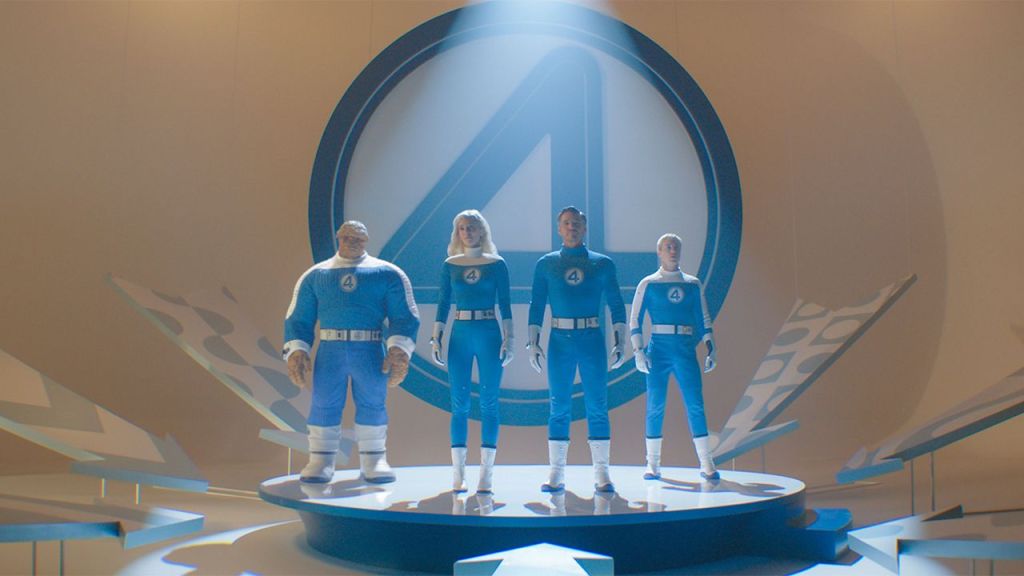
Marvel has long sought to modernize their characters. Tony Stark is no longer the womanizing drunk who builds weapons for the military; now he is a “futurist” who seeks to make the world a better place while peppering the audience with the latest buzz words. Peter Parker’s sweater vests and thick glasses are long gone, out of date in a world where being smart is cool. Even Captain America and the Black Widow, characters so drenched in WWII and Cold War pathos that they leave puddles on the floor, have seen those conflicts sandblasted off of them in the movies and more recent comics.
But every attempt to update the Fantastic Four, no matter the medium, has been met with resistance. From Sue Storm’s costume getting a 4-shaped boob window to semi-evil Reed to Fant4stic making them into soldiers on the run, fans of the team have reacted more with groans than cheers at Marvel’s attempt to bring the Fantastic Four into the modern age.
The team has always felt as if they were stuck in the 1960s. A world where science seems one step away from the impossible, where the local tough guy is just a big sweetheart, where the hot shot with a girl on his arm is greeted with “Oh, that scamp,” and the girl of the group keeps them all together. The Fantastic Four often feel like they have stepped out of Leave It To Beaver, or a Marvel version of Pleasantville where every problem is solved in an hour and even the villains are invited over for Sunday Supper.
So rather than fight against the current Disney has decided, for their first outing as a team (a variant of Reed having already appeared in Doctor Strange and the Multiverse of Madness), to embrace nostalgic, retro-futiristic charm in The Fantastic Four: First Steps, crafting an alternate world that imagines that the reality promised to us by those old B Movies and The Jetsons came to be.
This choice gives the film its own unique, yet timeless feeling, something Marvel has not attempted since Captain America: The First Avenger was released 14 years ago. With fans complaining that Marvel has become stale and “Superhero Fatigue” is in full onset, the world of the Fantastic Four — an idealized retro-future Earth that feels like the flip side of Fallout’s World-Gone-Wrong — at once feels ironically fresh and new.
A Family Affair
Taking place four years after the Fantastic Four went on their life-altering mission to space, the team is well established and comfortable in their own skin when the film starts. The standard tropes that haunted other Fantastic Four stories, such as Ben Grimm dealing with his transformation, Reed’s guilt, Johnny’s arrogance, and Sue’s perceived weakness, are nowhere to be found.

Ben seems (for the most part) comfortable in his own skin, with only one or two small moments to remind us that there is a human under that rocky façade. There’s no Ben hiding his face as he walks down the street, trench coat collar pulled up. Instead, he greets excited children while bringing home groceries, no different than any other person. The tortured man who thinks himself a monster is barely felt here; the name “The Thing” is perhaps only uttered ONCE, with Ben being just Ben.
Reed’s struggles are with managing the burdens of protecting his world and his family (and not always in that order). The heartless Mr. Fantastic the comics often showcase — who acts more like a robot than a human, and struggles to understand emotions — is not here. It’s impossible to image this Reed sending a letter to Sue stating that his cold mind cannot understand her “human feelings” as he did in Civil War. Instead, Reed is a man who manages anxiety by trying to counter threats before they can even occur. He knows it isn’t healthy, but he can’t help himself — and he takes great offense to people who think him a cold thinking machine for these instincts.
Where it would have been easy to make Johnny the comic relief, with him being the goofball that plays pranks and sees his powers as a way to get laid, First Steps presents a Johnny who has reached the point in his life where he is ready to truly grow up. Like many young adults entering their 30s, one gets the sense that Johnny looks back at his youthful follies with exasperation and embarrassment. The Johnny who plays pranks on Ben and jokes at the wrong moment is there, but it is tempered with the maturity that shows he is growing closer to becoming the man his family always hoped he could be. Indeed, his subplot shows Johnny’s brilliance, eliminating the issue other Fantastic Four media has: the question of why Johnny was even on the mission to space in the first place. This is a Johnny who can be just as smart as his sister and brother-in-law, he just needs the world to notice. In fact, Johnny, for this reviewer, is the highlight of the film.
While the world may think of Mr. Fantastic as the leader of the team, it is Sue who proves that when the chips are down, she is the one that the others turn to. It never falls into the Team Mom trope that often pops up, but rather respect for her inner strength. Towards the end of the second act, when the men are lost, it is Sue who steps forward and gets people to listen. She balances the strength, smarts, and bravery her family has, blending them into one.
The four leads shine in this film, and the cast’s chemistry is felt. There are only a handful of short scenes where they are on their own; a majority of the film features them as a team. You believe these are people that have known each other for years. Pedro Pascal’s Reed and Vanessa Kirby’s Sue do not have the gooey romance of newlyweds, but rather embody a relationship that existed even before they become heroes. Ebon Moss-Bachrach’s Ben Grimm and Joseph Quinn’s Johnny have moved beyond their teeth-clenching rivalry and become dear friends who tease each other but drop it in seconds, knowing that its all in good fun.
While one wishes there was a bit more between Ben and Reed to show off their friendship, as well as Johnny and Sue’s family bond, the time the team has together more than makes up for this. They work together flawlessly, with action scenes showcasing the trust and faith they have in each other just as much as their quieter scenes show their deep love for their family.
A Lived-In World, For Good And Ill
Much like DC’s Superman, First Steps drops audiences into the world with little fanfare. Indeed, the standard Marvel Title Card only lasts seconds before we find ourselves at the Baxter Building, watching as Reed prepares for dinner and Sue prepares for their lives changing forever. These first 20 minutes showcase the world and its characters for the audience, letting them see that this version of Earth has its own history.
Famous battles the Fantastic Four have already had, and the work they have done to help the public, are hinted at, indicating why they are so globally beloved; a scene at the United Nations shows only one country refusing to participate when Sue Storm calls for peace — and that nation will play a significantrole in their future.
While the opening 20 minutes work to established the cast and the world, its choice to jump back and forth through time (from the events of the family dinner to a talk show detailing the history of the four) at times becomes quite jarring. One moment the Fantastic Four are appearing in front of a studio audience, the next they are at home arguing about eating cereal before dinner, and then they are back at the studio. Thankfully by the time the Silver Surfer arrives, the film settles down and finds its footing.

The arrival of the Silver Surfer introduces the greatest threat this world has ever faced. Reed gets to show off his brilliance, tracking the Surfer and discovering the trail of consumed planets the Surfer’s master, Galactus, has left across the universe. The team, understanding the threat, refuse to merely react. They go on the offensive, seeking out Galactus to try and find some way to save their planet, leading to a grand spectacle of space travel that even the Guardians of the Galaxy trilogy has not produced.
It is, however, this meeting that changes the stakes of the film and also alter the threat. While much is made about Galactus consuming the Earth after the meeting between him and the team, his end goal — and their concern — changes. The global threat is shrunk down and while it works to make the story personal for the team, it harms the threat that Galactus should be.
(Spoilers in the video included, but…it’s an officially-released clip!)
It has been said of heroes that their greatest strength and weakness is their family. That is very true here. In order to make the threat of the Devourer a personal mission for the Fantastic Four, the global threat is neutered. The danger to the people of Earth is eliminated, even if the film tries to act like it is still there.
The film’s plot feels as if it were a comic book miniseries that was pitched as 12 issues, only to be reduced to six. The plot feels like it’s being rushed through in order to get to the end, because the creators weren’t given the time they needed. Events are missing, and character beats that would drive home the danger have been cut.
For the most part, the lead actors do not suffer from this. Sue, Reed, and Johnny all get full story arcs. Ben is the odd man out, with his character reduced to feeling like a supporting cast member and his subplot finished before it even began, if it can even be called that. Thankfully, the personal story that all the team shares is strong enough to make this only noticeable upon rewatching.
New World, Same MCU Issue
At this point it has become a cliché that Disney and Marvel do not know how to properly use their villains. They will create interesting, engaging, entertaining foe, and then allow them to be reduced to non-threat, or killed off before they have a chance to truly shine. The graveyard of Marvel Cinematic Villains is filled with “What If…s.” Sadly, Fantastic Four: First Steps continues this trend.

Julia Garner’s Silver Surfer is a woman who made a deal with the Devil. In the name of saving her world, she agreed to find more planets for Galactus to consume. Her choice is contrasted with the choice the Fantastic Four must make, and the ease in which she seemingly made her decision, compared with the team’s stubborn determination not to surrender, is supposed to drive her character arc. Unfortunately, not enough time is allowed for the Surfer to realize what she has done. In the key scene for her arc, when the ramifications of her actions are shown to her, she reacts in grief… only to within seconds brush them aside. The pathos of being forced to work for the very being that forced her into her impossible choice (and now can torture her on a whim) is not there. It is truly a shame, as Garner clearly has the acting chops to make the Surfer into an almost Faustian character, but instead is left to merely stare emotionless into the camera while delivering lines.
As for the Surfer’s master, Ralph Ineson’s Galactus, fans have been waiting decades to see a comic accurate version on screen, and will be pleased with his appearance. Gone is the strange cloud that threatened to overwhelm the Earth. Now, audiences are given Galactus, flying around in his great ship designed to consume planets like Unicron in Transformers: The Movie, to provide the Devourer with the barest relief for his hunger. The design might have been updated, adding more texture and detail work, but this is the Galactus fans have read about in comics for six decades.

Sadly, after the initial awe of the character is done, what remains is little more than a giant in fancy armor. Like The Fallen in Transformers: Revenge of the Fallen, Galactus spends nearly all his screen time on his throne, letting his minion mix it up with the heroes. And when he does arrive, he does little more than stomp around. The great threat of Galactus comes off as no different than any other giant that we have seen on our screens.
The script tries to give him more motivation, perhaps even some sympathy. He talks about how he wasn’t always as he was and that his hunger is great. But other than two brief moments of him bringing this up, he is little more than a colossus that is out to wreck things. In the comics, Galactus is a tortured being who only does what he does because he has no choice. He would stop consuming planets in an instant, but cannot. It is not evil that drives him, but instinct. Here, Galactus wishes to be free of his curse, but is never given the time to make audiences wonder if, perhaps, he is deserving of his freedom.
Not helping matters is the sound mixing for the character. The grand, powerful voice one expects for a giant who uses skyscrapers as handrests…just isn’t there. Instead, he speaks like a normal person. The characters do not react to the boom that should come from lips that big and it further weakens the character. Indeed, strip away the armor and the film is left with just a giant stomping about like a monster from the Showa Era of Godzilla. When video games such as God Of War (2018) have perfected the art of making massive beings feel massive, this is an unforgivable error.
The majesty of the villain can only last so long, and soon he becomes just another Big Guy that must be knocked down.
You’ve Taken Your First Step Into A Larger World
One of the fears around this film was that the anticipation of Avengers: Doomsday would harm it, forcing the story to serve as setup for that film. There is good reason for that, seeing as the team’s greatest villain will be taking lead in the next two Avengers films, and comments by the writer of Doomsday suggest Reed will be taking a leadership role.
Thankfully, First Steps avoids that almost completely. Save for one small tease, and a title card telling people the Fantastic Four will be returning for Doomsday, this story is a stand-alone adventure that needs no previous watching, nor is it bogged down by setup. This allows the film to be its own thing.
And we should all be grateful for that.

While the team will be journeying to the Main MCU Earth next time we see them, fans will be hoping that this won’t be the last time we see them on Earth-828, protecting their world as only Marvel’s First family can. One can only hope their next go-’round gives them threats to match them.
Final Verdict: The Fantastic Four: First Steps is an entertaining film that allows the Fantastic Four to prove why they will be the next fan favorites of the MCU. The Lead Four carry the film, helping to cover up an overly stuffed script and underutilized villains.
4 out of 5 Stars

 Emerald City Video
Leave a comment