

“James Gunn is already showing that he understands that Superman, the alien from a doomed world, is at his core the most human of heroes”
In the most recent clip for James Gunn’s Superman, an exasperated Superman looks about the Fortress of Solitude, which has suffered damage. Not from Lex Luthor and his cronies, like we have seen in earlier trailers, but from a far fluffier figure: Krypto. The Superman Robots can only stand there as Superman twists about, looking at the carnage the pup has caused, before saying the first thing that comes to mind in the face of such destruction.
“What the hay?!?”
In that moment it isn’t the Man of Steel speaking. No, this is Clark Kent, farm boy from Kansas, responding as so many other people from the American Midwest have upon discovering something that leaves they just so overwhelmed they don’t know what to do. Many farmers have come home to find that the family dog has caused a mess, those that were supposed to be watching him just standing there unsure of what to do, unable to explain what happened.
While some might hear this statement and think that it is nothing more than a corny, clunky way to call back to Clark’s roots, Gunn’s choice here is perfect for reminding the audience of something that has gotten lost in recent years when it comes to Superman: Clark Kent is the man, Superman the mask.
Superman Is What I Do, Clark Kent Is Who I Am

Despite the problematic nature of lead actor Dean Cain in recent years, the show Lois and Clark: The New Adventures Of Superman remains a high-water mark for the handling of the world of Superman. This is mostly because it understood the unique situation that Clark Kent finds himself in better than nearly all other media, save perhaps the recently-concluded Superman and Lois. Upon proposing in the Season 2 finale to Lois, the first episode of Season Three has her asking who just proposed: Superman, or Clark? Revealing that she has already learned about his dual identity, she presses him on these two halves of himself, how “Superman” goes about pretending to be Clark Kent.
Clark, for his part, counters with the line “Superman is what I do, Clark Kent is who I am.” It is this line that perfectly sums up the Clark Kent/Superman dynamic: every feat of strength, every life saved, is being performed by Clark Kent. But every friendship he makes at the Planet, every article he writes, is not being written by Superman. Superman is a mask — a false identity that allows Clark to protect his loved ones. Clark is the person punching in for the day, and Superman is his job title.
Many industries have such masks in their job. Retail workers talk of their “Retail Voice”, that calm, measured tone reserved for the raging customers angry they can’t return used sneakers without a receipt. Nurses too, who must be brave and steady even as the world goes mad around them, adopt these personas. They are dropped as soon as they are out the door and if not, it is pointed out by friends and family. “Do not use your retail voice with me” is something nearly every cashier has heard from loved ones when dealing with an argument that feels like it is going nowhere.
We see this also with Clark. In the film, he suggests letting Lois interview him as Superman. At first he is very joking and casually, teasing her like any couple would. But when it is time for them to actually do the interview? The “Superman Voice” comes out. It is a different voice, a different rhythm. His posture changes. Clark slips into the role of Superman. Yet when the interview begins to touch on raw nerves, it is Clark’s actual voice that bursts out, to declare what he is really feeling. The Superman stance leaves and he slouches, he paces, he waves his hands about.
The mask falls away.
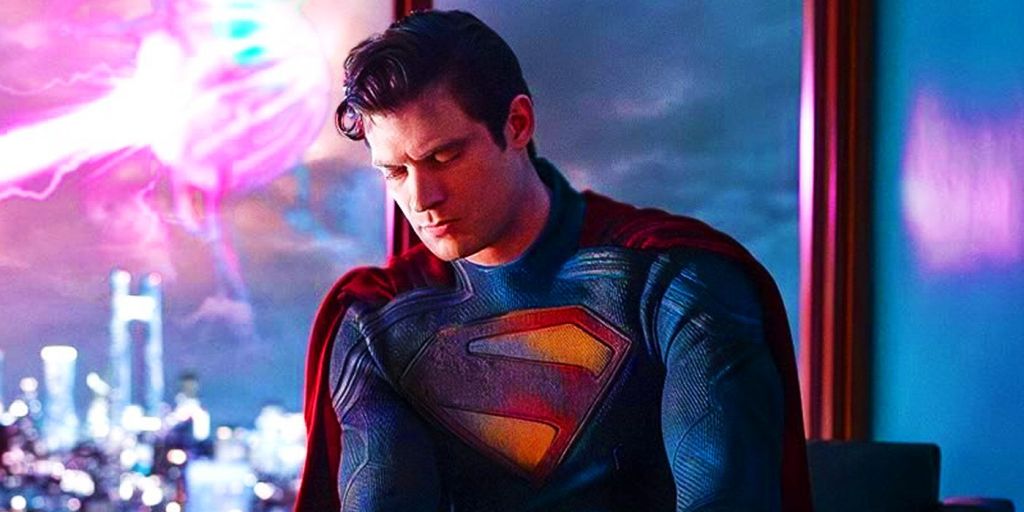
It is understandable why fans might not understand this duality. After all, two of the biggest heroes in comics, Batman and Spider-Man, are the reverse of this. Batman is the true man, the boy that lost his parents and swore to dedicate his life to make sure no one else suffered as he did. Bruce Wayne, meanwhile, is a disguise that Batman uses to move about amongst the people. Spider-Man is what happens when Peter Parker is able to finally speak aloud all the thoughts he kept bottled up, the snark and the wit that he had to hide all throughout his childhood — the secret sarcastic comments that everyone thinks, allowed to finally be declared proudly.
As for other heroes, the line has become so blurred between the Hero and Civilian that it is impossible to tell where one begins and ends. The “secret identity” is a dying thing. Hal Jordan’s Green Lantern disappears from his civilian life for months at a time to the point that his girlfriends disappear from the comics, never to be spoken of again. The X-Men don’t even bother to hide who they are. Thor hasn’t gone by Donald Blake in decades. Only Superman and The Flash remain dedicated keeping these divides between their two lives, with their civilian selves being their True Selves.
So with fans bombarded with heroes whose “secret identity” is just them in colorful outfits (or rather, their civilian lives amount to heroes forced to slum it in casual wear), it shouldn’t be surprising that many people forget that Superman is not, for all intents and purposes, “real.” He is a creation of Clark Kent, the real person who just wants to do some good.
The God That Stands Above Us
In Superman media, when retelling his origins, there is often a moment when Clark Kent leaves to explore the world and find out “who he is.” Sometimes it is after he is told by his parents that he is an alien. Other times it is this journey that helps him learn. But this journey around the world is what allows him to see the world is a big place, yet also so small. It shows him that people are just people, no matter where they live.
However, there is a tendency for some writers to make this the moment where Clark Kent, as he has been his entire life, suddenly ceases to be. He is now Kal-El, and Clark becomes a false form he wears to hide amongst humanity. In these stories, Clark, now Kal-El, begins to see himself as Kryptonian. Not Kryptonian first and human second, but Kryptonian only. Clark Kent leaves home and never returns; Kal-El is the one to appear in Metropolis. Much like in Batman Beyond, where Bruce Wayne reveals that even in his own head he calls himself “Batman” when talking to himself, Clark thinks of himself solely as “Kal-El”.
This view misses the core of what makes Clark Kent as Superman such a compelling character. He is the man who can do the impossible, but in his heart is still a simple farm boy. It is why he is willing to believe that there is good in people. Why he, time and again, goes to Lex Luthor and demands he stop what he is doing. Even if every past instance has shown that Lex isn’t going to stop, Clark tries to convince him to see reason.
In the final episode of Transformers: Beast Wars, “Nemesis Part 2”, Megatron and Optimus Primal have an exchange that could have been spoken by Lex and Clark:
“‘And there came a hero who said, “‘Hurt not the earth, nor the seas, nor the trees, nor the very fabric of time. But the hero would not prevail….’”
“Finish the quote, Megatron: ‘Nor would he surrender!’”
This is not a view he got from Krypton. This is a view that he developed while he watched his parents work the fields, knowing that one growing season might be a complete wash, but they still had to try. It is a human quality, and at his core, Clark Kent is the alien who is a human. Movies, shows, and comics that depict him as rejecting his life as a human and seeing himself only as the Alien do not understand Clark Kent the character. He is not someone who, in his free time, broods in his Fortress of Solitude, dreaming of, as Five For Fighting sang, “a home [he’ll] never see.” He is out with friends sharing laughs. He is cheering on his beloved Kansas A&M (or Metropolis U or one of the other colleges, real or fictional, that lay claim to him) having a fall classic on the gridiron. He is worried about deadlines and remembering to pay the water bill.
This is why Lex Luthor never figures out who Superman is: he has the capacity to reason that Superman is Clark Kent, but Lex simply cannot believe that Superman would lower himself to act like a common man. Not with his powers.
When the Deconstruction Becomes The Norm
In recent years, there has been more media deconstructing the Superman mythos than there has been about the Superman Mythos. The film Brightburn (from producer James Gunn) images a young Superman becoming a killer, using his powers to slaughter people just because he wants too. The Boys has Homelander, who attempts to act like Superman, only to reveal that in reality he is a sociopath. The Injustice: Gods Among Us series of games and comics show a Superman who becomes a tyrant, believing that he and he alone has the right to decide what is right. Invincible has Omni-Man killing his team, nearly beating his son to death, and then without a second thought cheating on his wife and creating a new family. One of the many theories about Marvels’ The Thunderbolts* was that the villain would be Hyperion, the Marvel pastiche of Superman who often is driven to evil; instead the Sentry/Void, seen by many as another take on the “Evil Superman” archetype, was selected.

It should not escape notice that when describing these films and shows, “Superman” was the name given. That is because all of these are “Evil Superman” but not “Evil Clark Kents.” Because Clark Kent CAN’T be evil. To make him evil is to tear away so much of who he is that he stops being Clark Kent. Even Ultraman, the Evil Doppelgänger of Superman, is known as Lt. Clark Kent and has his backstory radically altered in order to explain how he became the crime boss that he is.
Yet there is a subsection of fans, upon seeing footage of Gunn’s Superman, who bemoaned how he acts. They wish for him to be “The Stoic Alien.” To be “aloof and brooding.” To be “beyond us humans.” They claim that Gunn’s Superman comes off more like a film from the world of The Boys, where Homelander is portrayed as a “aw, shucks” hero, seemingly forgetting that Homelander is supposed to be a subversion of Superman, who is that kind of hero. They want their Superman to be darker, more violent; to focus on the fight; to have no emotions. Never laugh. Never smile. Never crack a joke.
In other words, they don’t want him to be Clark Kent.
The irony in all of this, of course, is that what they desire from Superman are the same thoughts that Lex Luthor, Darkseid, Mongul, and The Elite have concerning Superman: that he either must secretly feel himself above humans, or that he should see himself that way. They simply cannot understand why someone like Superman would use his powers they way he does. Why he would smile, joke, be corny, not take himself seriously, or show self-respect? All of this, of course, ignores the key point: Superman is the job, Clark Kent is the man.
With Gunn’s Superman, audiences are getting a film that is about the man doing the job. It is the story of Clark Kent, trying to do good. And he will have failures and successes. He will get upset when people question him, just the same as anyone else would after a hard day of work only to get second guessed by those that don’t understand what they do. He will blow off steam and he will grit his teeth in frustration. And he will also joke and laugh.
He will do what any one of us would do, if given his powers and his morals.
Because Clark Kent IS us: An alien with the heart of a human.




 Emerald City Video
Leave a reply to ECV Podcast – New Release Wall: Superman (2025) – Emerald City Video Cancel reply