
New York State has banned cell phones and other internet-connected devices from K-12 classrooms, and it is in no small part a reaction to vibes-based pseudoscience. The leading proponent of said vibes-based pseudoscience is the Jonathan Haidt, the Thomas Cooley Professor of Ethical Leadership at New York University’s Stern School of Business, whose book The Anxious Generation was a huge hit last year.
And it’s pretty easy to draw a direct line to Haidt from one of the most notorious cranks of the 20th Century.
In 1954, child psychologist Frederic Wertham wrote Seduction of the Innocent, a book that posited that comic books were a leading cause of childhood maladjustment. In the book, follow-up articles, and testimony in front of the U.S. Congress, Dr. Wertham blamed comics for kids being delinquents, depressed, homosexual, and socialists. His claims were based on his experiences in New York-area juvenile reformation facilities, and the book nearly destroyed the American comic book industry.
At the time, comics were heading in the direction familiar to fans of European or Japanese sequential art — genres were broadening, audience demographics were broadening, and the idea that comics were for everyone, rather than just pubescent boys, was beginning to take root.
After Wertham’s book and the ensuing moral panic, the industry self-policed with the creation of the Comics Code Authority, which severely limited what comics could depict and still get mainstream commercial distribution. It is not an exaggeration to say that American comics, as an industry and an artform, is still recovering from the damage done by Wertham’s book.
Looking at Wertham’s actual science, though, provides a cautionary tale: it’s largely anecdotal, cherry-picked stuff, informed primarily by the idea that when there’s correlation, and your gut tells you there’s causation, there must be causation. It’s just common sense!
The same can be said for Haidt’s work in The Anxious Generation, which claims social media is a leading cause of a spike in childhood anxiety and depression. Child psychology is outside of Haidt’s area of expertise, though, and there have been a number of studies on the issue. Generally, they indicate that any causation between social media and negative childhood mental health outcomes is marginal. There are a few outlier studies that say it’s more dangerous, and also a couple that seemingly suggest social media is actually good for childhood development, but on the whole, the studies are inconclusive, leaning toward the idea that there might be some connection, but it isn’t dramatic.
Haidt and his defenders will shoot back that the studies might be inconclusive but it’s just so obvious! It has to be true!
You can see a bit of that in action toward the tail end of this terrific video by Rebecca Watson, one of my favorite people on the internet:
I’m not an expert in this topic and, unlike Haidt, I’m going to let that stop me from writing thousands of words on it. Instead, check out this scathing writeup in Nature, written by an actual expert and citing dozens of studies.
Legislating based on vibes and bad science is bad practice, and New York State has responded to parents’ uneducated knee-jerk demands with a bad law that’s bound to be repealed quickly, since it fundamentally ignores key realities of modern life. But we’re stuck with it for now, in part thanks to this “viral” book from an author who already proved himself non-credible with his laughably bad 2018 book The Coddling of the American Mind, which was designed to validate right-wing talking points attacking education.
Ironically, back when he was still writing books about his actual area of expertise, Haidt famously argued that people who are emotionally invested in a point of view often fail to see the flaws in their own arguments. Two decades on, he’s actively engaging in that behavior.
And, to tie this all back around, Haidt is now dipping his toes into comics. Yes, really.
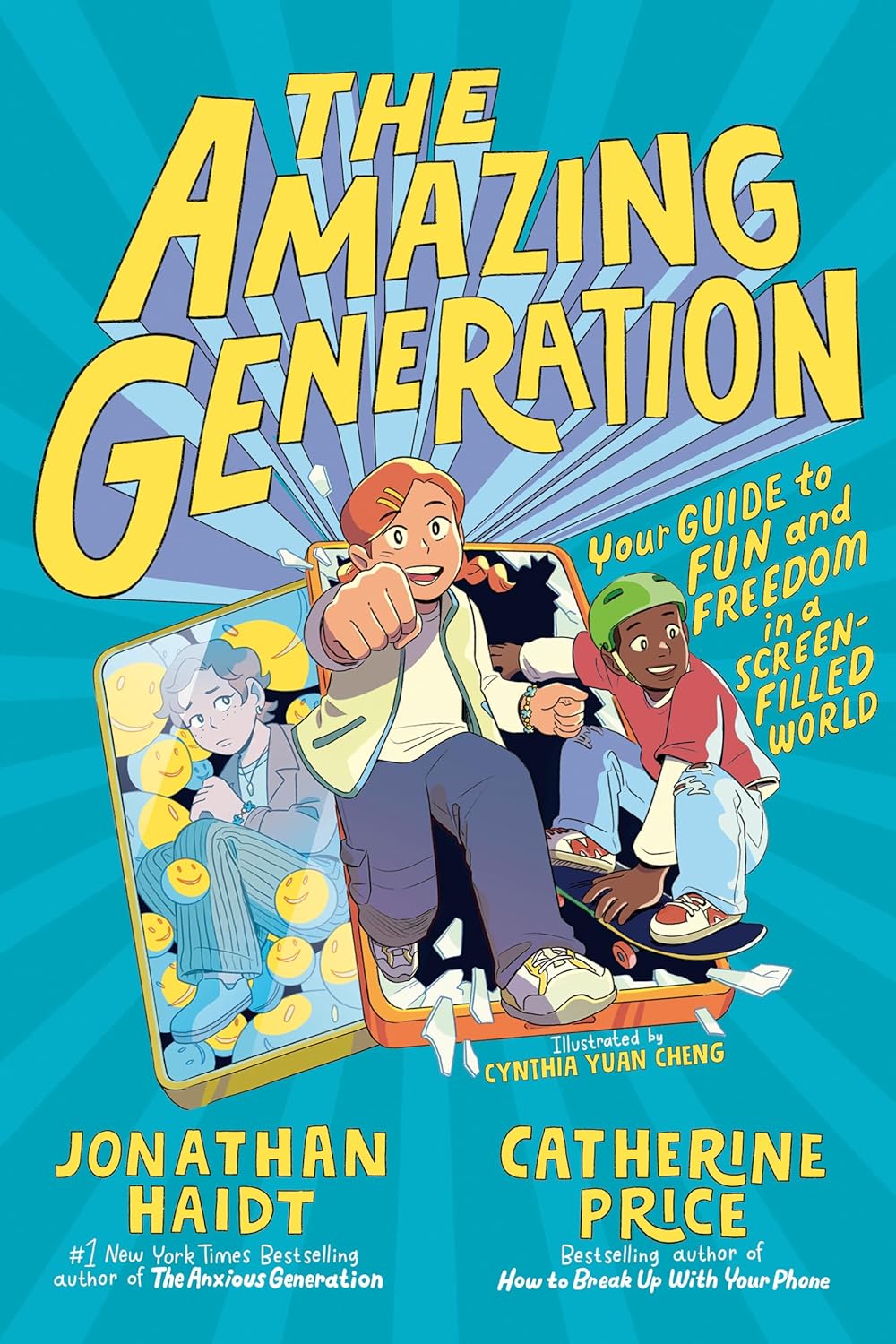
Haidt, along with fellow anti-phone activist Catherine Price and cartoonist Cynthia Yuan Cheng, has released The Amazing Generation. Touted as a graphic novel, the preview pages on Amazon show relatively little sequential art, but a graphics-heavy book that looks like a school workbook with some cartooning included to make it accessible and engaging.
I won’t discuss or review that at length, because I can’t see my way clear to giving him any money.
Historically, though, it isn’t good for anybody when a guy like this gets close to comics…!



 Emerald City Video
Leave a comment