

“The latest Superman film’s take on Clark’s biological father has many fans talking. But is there more to him than what is presented?”
Editor’s Note: The following article contains major spoilers for the film Superman (2025).
In the opening scene of James Gunn’s Superman, the title character (David Corenswett) listens to the message left for him by his birth parents (Bradley Cooper as Jor-El and Angela Sarafyan as Lara). Damaged and fragmented, it is translated by the Superman Robots, explaining who Clark is, where he came from, and that his parents love him.
A third of the way through the film, Lex Luthor (Nicholas Hoult) reveals to the world that he has recovered the rest of the message and presents his translation. In it, Jor-El commands his son to rule over Earth, mate with as many Earth women as he can, and create a new Krypton. This revelation turns much of humanity against Superman and leaves him utterly shaken, his belief in his biological parents torn apart and causing himself to doubt his mission on Earth.
It is a controversial change from the standard presentation of Jor-El and Lara, and one that still has viewers discussing it two weeks after the film’s release. Some audience members claim that the change “ruins” the character of Jor-El (and to a lesser extent Lara), while others praise it for allowing Clark to move beyond being Kal-El and remember that he is Clark. Still others are questioning what this will mean for Supergirl when her own movie comes out next year.

However, in the time since the film has come out, another theory has taken root in fandom: the message is not what Lex presents it as. And while the film goes out of its way to state that it has to be correct (and filmmaker James Gunn has done the same in interviews), with even Luthor telling one of his allies that he didn’t doctor the message, there are clues and hints that there is more to the message and the translation than what we are first told.
Jor-El’s Really Good PR Team
Before examining the theory, it is worth noting that Gunn isn’t the first to entertain the idea of an evil Jor-El. While “the “tragic scientist who just wants to ensure his son lives a good life” is what most of the public thinks of when they hear the name Jor-El, he has not always been presented as such. Indeed, in his very first appearance, Jor-El (or rather Jor-L) wasn’t even related to Superman (having in fact debuted before his son by a full year). Instead, he was a detective from the year 3000 AD, who battled “space bandit-queens.”

Later in the Silver Age of comics, Jor-El would develop into the character we know, gaining the E in his name (likely for copyright-related reasons) and becoming the inventor of the hovercar, discoverer of the Phantom Zone…and in some tellings the creator of the AI Brainaic.
(The fact that this would make him Krypton’s Elon Musk does potentially weigh towards him being evil, but the benefit of doubt will be given.)
In the Silver Age, it was established that Jor-El discovered that Krypton was doomed, and created the rocket that would save his son, sending Kal-El to Earth as he met his own end with dignity. His final message to his son would inspire his life’s mission.
But in recent years, during the DC Rebirth Era, a new version of Jor-El was presented in the main DC Comic Universe. Having been saved by Dr. Manhattan of Watchmen (something that surprisingly Zack Snyder never considered doing) Jor-El became disenchanted with humanity, believing Earthlings did not deserve to be saved. Taking on the name Mister Oz, he would attempt to drive Clark and his family from Earth, and only withdrew when Clark forced him to confront the fact that he was going to attack his own son. This version of Jor-El would also took Clark’s child Jon with him, resulting in the character being “aged up,” and was eventually revealed to have created the being that actually destroyed Krypton.
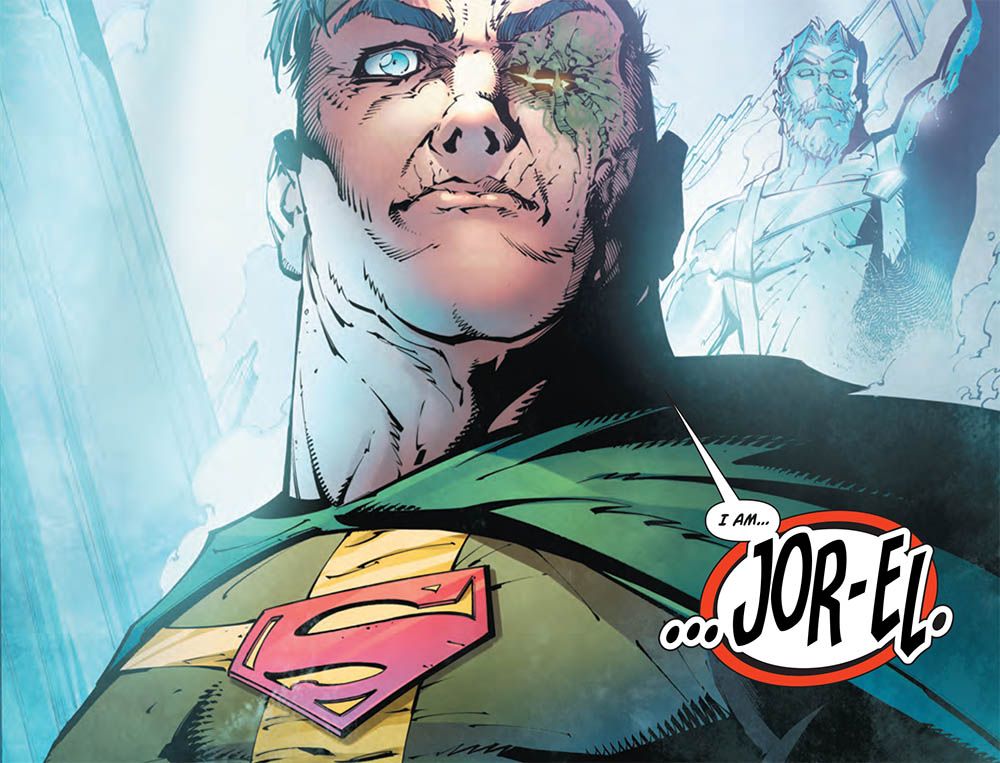
Other evil Jor-Els include one from Superman Adventures, who murdered millions of Kandorians to send Clark back to his home dimension; Superman: The Last Family of Krypton’s Jor-El (a control freak who micromanaged all of humanity to the point that Lex Luthor commented he had a god complex); and a Jor-El who interacted with Scott Adams’ Dogbert in Dilbert, which in and of itself instantly made him evil.
Two versions of Jor-El appeared on Smallville, with the main Jor-El portrayed as a flawed man who saw empathy as a weakness, while the A.I. Jor-El, which contains only his intelligence, was a violent, callous monster who was willing to torture and brutalize his own son.

My Adventures With Superman also played with the idea of an evil Jor-El in their first season, presenting him as an emperor who ruled over the Kryptonian Empire, which was feared throughout the galaxy. The second season toned that down, revealing him to be a noble emperor stuck with a militaristic Krypton.
So, yes: “evil” Jor-El is not a creation of Gunn’s and, should he be going down this path, could open up many interesting stories. But that does not mean Gunn doesn’t have something else planned.
Lost In Translation
Much like in My Adventures With Superman, the message that Jor-El leaves for his son in Gunn’s film is not in English. The message, in Kryptonian, is translated by the Superman Robots (and later Lex Luthor), with a dubbed voice providing a translation of what Jor-El and his wife Lara are telling Clark. This is a key change compared to other media, and allows for the possibility of mistranslation.
A danger that comes with translating any message is the loss of meaning behind certain words. Much has been written about the Christian Bible, the most translated work in human history, and the many errors that have come trying to translate it. Was Eve, for example, made from Adam’s rib, and thus is subservient to him? Or from his side, which would make her his equal?
More recently, attempting to dub Godzilla Raids Again to English resulted in the dub actors breaking down laughing over nonsensical dialogue, including one character explaining that he was actually a coward by declaring, “Ah, banana oil!” The anime community is filled with near blood feuds over which translation is the correct one for certain series, with one issue being translators who are overly literal (which can result in idioms that make no sense and stilted dialogue that sounds unnatural). Others are seen as too liberal in changing things, thus disrespecting the creator’s intent. Sometimes, this happens when trying to insert or apply the translator’s own (or just more broadly Western) values, such as removing slurs a heroic character might say or toning down their sexist comments.
In Superman, the message presented early on has one of the trademarks of word-for-word translation, where Jor-El and Lara tell their son “we love you more than land”. It is an odd phrase, perhaps one that makes more sense in Kryptonian but did not translate well to English. Think of it as being similar to how for the English a “dog-eat-dog world” is a common expression, but for a foreign speaker can be quite horrifying.
The argument against this point is that while some words might be considered clunky, the message itself should be roughly the same. To that we must turn to another billionaire industrialist: Jimmy James.
Super Karate Monkey Death Car
On the show Newsradio, business mogul Jimmy James wrote an autobiography, Jimmy James: Capitalist Lion Tamer, only for it to do little business in the United States. However, he was delighted to discover that it was a huge success in Japan. Believing that there must be something special about their version of the book, Jimmy — rather than simply rerelease the book in America — paid to have the book translated back into English from the Japanese printing. At a reading of the book, he discovers that it has been retitled Jimmy James: Macho Business Donkey Wrestler. The re-retranslated book also includes such gems as “I never doubted myself for a minute, for I knew that my monkey strong bowels were girded with strength” and “Bad clown making like super American car racers, I would make them sweat. War, war!”
While played for laughs, the episode shows just how difficult translation can be.
The Rosetta Stone, the most important find in linguistics, is the only reason we have any understanding of ancient Egyptian script. Indus Valley script, Linear A, and Olmec Writing still remain untranslated despite the fact that we have examples of them, mostly due to their unique writing styles being so alien to us. Without a clear point of comparison, it is nearly impossible to determine their meaning.
Jor-El’s message presents an even more difficult problem: much like ancient earth languages, it is fragmented and damaged — but the Kryptonian Rosetta Stone used to translate it is very limited, and was created by beings programmed by Superman himself. That same method is then used by Lex Luthor for his own translation. There is no single long example of Kryptonian (sometimes called Kryptonese) language with an Earth counterpart to provide us with any kind of one-to-one translation. We must rely on what these two groups and their small fragment of video have to say, and both groups have very particular desires when it comes to what they want to hear.
Confirmation Bias
Superman is open about his beliefs and values: he wants to help people, and he believes people are naturally good. While Superman Robot #4/Gary (Alan Tudyk) claims they have no emotions, we see repeatedly this isn’t the case, and they do care for Superman. It is only natural for robots who are maintained by Superman to also look for the good in others, and thus choose a translation that follows that belief.

Lex is the opposite. He is rather firm with Vasil Ghurkos (Zlatko Buric) that he did not create the message, but this cannot be taken as Lex getting the message right. As with Superman, Lex has confirmation bias. He wants the translation to reveal that Superman is the enemy of humanity, and when presented with a choice of words he would naturally select one that goes against Superman, Lex assumes his translation is correct. Of course, this does not mean it is correct; Lex (established in this movie as a careless scientist who chooses self-interest over the common good) is choosing Adam’s rib rather than his side.
There is another factor that must be considered with Lex’s translation as well: time.
In the film Lex’s henchmen release the baby kaiju while he is at the Fortress of Solitude to serve as a distraction for Superman, to keep him from returning there. Based on the weather and the sunlight seen in the film we can place Superman in the summer. At most, assuming this film takes place on the Summer Solstice (the longest day of the year), the henchmen would have released the baby kaiju at 9:30 p.m., and the fight ended by 6 p.m. the next day.
That gives Lex and The Engineer (María Gabriela de Faría) 20.5 hours at most to return to the United States, recover the full message, study it, and then get a guest spot on The Sphere to present his findings. For comparison, the Rosetta Stone took 23 years to be fully translated by a team of linguists. While some time might have been shaved by Lex using his Pocket Dimension Portals, we still see him use a plane to get to the arctic, reducing the time he would have to get the team of linguists to study the message. This creates the potential for another strike against Lex’s translation being accurate.
When Superman and the Justice Gang discuss the message, Mr. Terrific states the translation is authentic. However, he does not say this because he actually viewed the original message himself; instead, Terrific states it’s because he trusts the same experts that Lex does. This statement, though, doesn’t consider two key pieces of information:
First, Lois says in-story that Lex has a cult-like following of people that believe he will create a new paradise. We see that his workers worship him almost as a god. They are fully on board with destroying Superman, never showing any regret for their actions, and they see no problem with imprisoning people in a secret prison. Their concerns about the destruction of Metropolis disappear the moment Lex tells them to let the people die. So, it’s fair to assume that if Lex tells them, “This message must hold a dark secret” or “I have discovered something sinister,” they will agree, as they have the same confirmation bias. Personal integrity can not be considered in this case.
Second, Eve tells Jimmy that Lex has been imprisoning anyone that wrongs him in his pocket dimension, including scientists. While the linguistic experts might not want to risk their careers with a haphazard translation, it’s far better to be later proven wrong than to be thrown into a hidden prison because you disagreed with Luthor. The safer option would be to accept what Lex states, and quietly keep your opinions to yourself. While they might think that Jor-El is saying “Find a wife you can love” if Lex says it’s “Find many humans to mate with” they are going to agree with his translation in public.
Like Opening Up Action Comics #1047
The biggest argument against the message being mistranslated is that the movie never says it is. Those against the theory state that Gunn would have revealed the truth in the final act, using it as the emotional push Clark needs to win the day. Revealing it in another movie would feel like a retcon due to fan backlash, or even sloppy writing. One does not put Chekhov’s Gun on the mantle, and then fire it in a different play.
Supporters though have pointed out that Gunn has been clear that Superman was designed to mimic the feeling of reading a random Superman comic, from starting the movie in medias res, to characters appearing with little introduction, to not rehashing Clark’s origins, and even down to the opening text feeling like the narration boxes at the start of most ongoing comics. With this in mind, the reveal that Jor-El’s message hasn’t been properly translated is merely a plot point for a later “issue” of the story. It is no different than Skeets reacting to a DNA scan of the Black Beetle in an issue of Booster Gold, and audiences learning a decade (and 1.5 reboots) later what he actually saw.
Furthermore, the movie doesn’t need Clark to learn the truth about the message, because that isn’t the moral of the film. The story isn’t about Clark learning his biological parents are good people; it is him accepting that he does what he does not because he was born to do it, but because he chooses to.
Perhaps the true message will be revealed in a sequel. Perhaps it will never be revealed. Jor-El might turn out to be a good man, an evil man, or a complex man who is neither one or the other.
What we do know is that Jor-El is the most macho of Kryptonian donkey wrestlers.




 Emerald City Video
Leave a comment